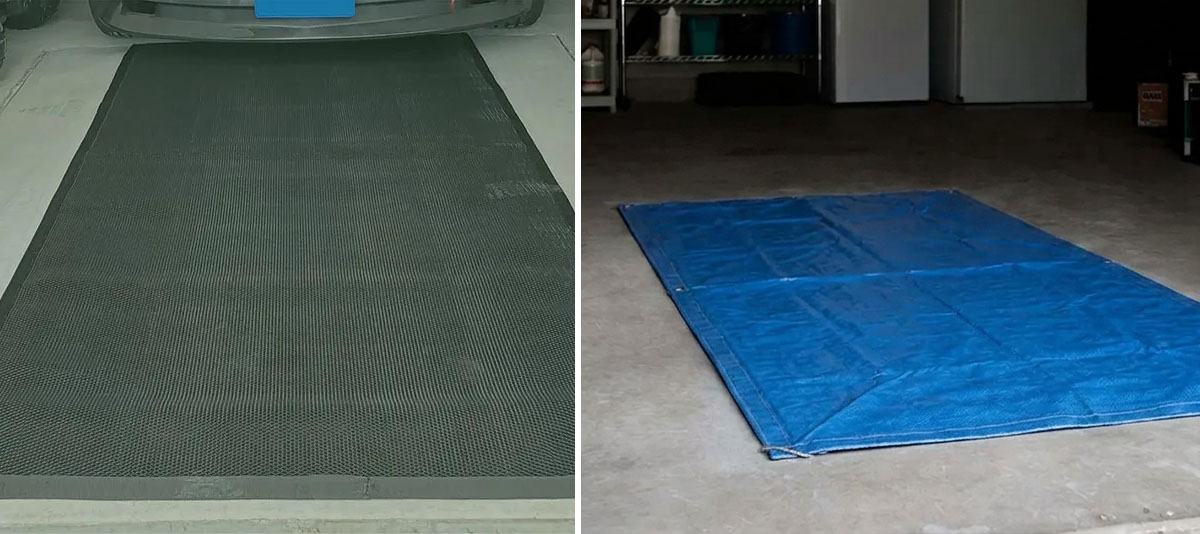
Start shopping for a tornado shelter cover and you’ll quickly discover the market isn’t what you’d expect. There’s no established product category. There’s no row of options at the hardware store. What you find instead is a collection of workarounds: rubber mats repurposed from other applications, vinyl covers that don’t fit right, and tarp solutions from Pinterest. A lot of “just put a mat over it” advice comes from people who’ve never thought hard about what a cover actually needs to do.
This post is a framework for evaluating whatever options you encounter—including ours. The criteria below come directly from what in-garage tornado shelters actually need, and they’ll help you recognize quickly why most improvised solutions fall short and what a purpose-built cover has to get right.
Criterion 1: Breathability
This is the single most important criterion, and it’s the one most improvised solutions fail entirely. A storm shelter cover that isn’t breathable doesn’t protect the shelter—it traps moisture against it.
In-garage underground shelters experience constant temperature differentials between the cool underground mass and the warmer garage air above. That differential produces condensation on shelter surfaces continuously. This is especially true during Oklahoma’s humid spring months and during the temperature swings of summer and fall. If a cover sits over the hatch and doesn’t allow vapor to escape, that moisture has nowhere to go. It concentrates against the hatch, lid frame, and hinge points—exactly the metal surfaces most vulnerable to corrosion.
A vinyl tarp or rubber mat actively makes this problem worse. You’ll sometimes see the smell intensify within weeks of installing a solid cover—that’s the trapped moisture environment accelerating microbial activity. The cover has to be vapor-permeable to do its job.
When evaluating any cover, ask one specific question: does this material allow water vapor to pass through?
Criterion 2: Pest and Debris Barrier Effectiveness
The cover needs to block pests and debris at the perimeter—meaning a complete seal around the crown, not just coverage over the top. This distinction matters. Most of what gets into a shelter doesn’t fall straight down through the hatch opening. It enters through the gap between the hatch frame and the crown surface, through vent openings, and through any point where the cover doesn’t make solid contact with the surrounding surface.
A cover that sits loosely over the top without overlapping the crown perimeter leaves the most common entry routes open. Spiders and crickets find gaps measured in fractions of an inch—and in Oklahoma, brown recluse spiders are particularly good at it. The effective overlap determines whether you’ve created a barrier or just added a layer on top of an open system. That overlap is how far the cover extends past the hatch edge and onto the surrounding crown surface.
Debris entry works the same way. Leaves and red clay dust blow into the gap between the cover edge and the crown surface. They end up in the same place they would without a cover—except now they’re trapped there instead of being swept away.
Evaluate any cover by asking: how does it address the perimeter gap? What’s the overlap? How does it handle uneven crown surfaces or slightly raised hatch frames?
Criterion 3: Vehicle Weight Rating
Most in-garage shelters sit between vehicle wheel paths. Most covers will experience some vehicle traffic—whether from tire contact or from heavy equipment in a working garage. A cover that can’t handle this load will deform, crack, or fail at the perimeter binding within months of normal use.
Rubber mats typically handle compression load reasonably well but fail at the edges. The binding tears away from the mat material under repeated load. Window screening and lightweight mesh products fail structurally under vehicle contact. The material needs to handle both compression and abrasion without losing its structural integrity or its perimeter seal.
Ask for the rated load capacity. Then ask specifically whether the perimeter binding—not just the face material—has been tested under vehicle contact. The binding is almost always the failure point.
Criterion 4: One-Person Deployment in an Emergency
This criterion is about what happens at 2 a.m. when a tornado warning sounds. You have ninety seconds to get your family into the shelter. The cover needs to move in one action by one person—no unfolding, no unfastening, no fighting with a tangled tarp.
Heavy rubber mats require two people or significant effort to move quickly. Tarps tucked or weighted at the edges require fumbling with attachment points under stress. A cover that rolls to one side in a single motion—or lifts cleanly without also requiring hatch management—removes friction from the highest-stakes moment it will ever encounter.
Weight is the key variable. The cover needs to be heavy enough to stay in place during normal garage activity. It also needs to be light enough for a single adult—or an older child—to move immediately without preparation. These are competing requirements that deliberate design must resolve. Ask: what does the cover weigh, and what’s the deployment motion?
Criterion 5: UV and Heat Resistance for Oklahoma Conditions
Oklahoma garage environments expose covers to significant UV radiation through windows and open doors. Add to that the high-temperature cycling this site has documented elsewhere—interiors reaching 110°F to 120°F in July and August. Most synthetic materials degrade under prolonged UV exposure and thermal stress, becoming brittle, cracking at fold points, or losing tensile strength.
A cover that performs well in its first year but turns fragile by year three isn’t protection—it’s a false sense of security. Ask specifically about UV stabilization built into the material itself, not just a surface coating that wears away. Also ask whether the product has been evaluated for performance after extended temperature cycling.
Criterion 6: Warranty Compatibility
Most shelter manufacturers include warranty exclusions around condensation damage, hardware corrosion, and moisture-related issues. A solid vinyl cover or a tarp traps moisture against the shelter. That can contribute to exactly those conditions—meaning that cover becomes an argument against your warranty claim if something goes wrong.
A breathable cover, by contrast, doesn’t create the sealed microenvironment that those warranty exclusions anticipate. It’s not a structural modification. It doesn’t touch the vents. It doesn’t block the airflow the shelter’s design depends on. At least one shelter installation company reviewed our cover specifically on this question and confirmed it doesn’t affect their warranty. Ask any cover provider whether they’ve had that conversation with shelter manufacturers, and what the answer was.
Why Most Alternatives Don’t Meet the Criteria
Rubber mats handle vehicle weight reasonably well and block some debris, but they fail on breathability (they seal moisture against the hatch), perimeter coverage (most don’t overlap the crown), and emergency deployment (heavy, no clean removal motion).
Vinyl covers typically address the perimeter gap better than mats but fail decisively on breathability. They’re designed to be waterproof—which in this application means moisture-trapping. They also often fail on vehicle weight rating at the binding, and they degrade faster under UV and heat cycling than materials built for outdoor use.
Tarps and DIY solutions fail on multiple criteria simultaneously: no perimeter seal, no vapor permeability, no vehicle load rating, no clean emergency deployment, and rapid UV degradation. The Pinterest approach to shelter covers looks reasonable until you evaluate it against what a shelter cover actually needs to do.
Only a purpose-built cover—one developed through years of iteration to solve these problems—addresses all six criteria by design. That’s not a marketing claim; it’s why the product category exists at all. The Take Cover shelter cover was built from the ground up to meet every criterion above. The founder spent years searching for something that did and couldn’t find it. The evaluation framework is the story of the product.